Federal law sets the floor for texting in the U.S.: no marketing texts before 8 a.m. or after 9 p.m. in the recipient’s time zone, consent for automated marketing, and opt-outs honored fast. A growing list of states adds tighter windows, daily caps, stricter consent and registration. This guide shows what each of those states requires in 2026, and how to set one sending schedule that stays inside all of them.
Key takeaways
This article is general information for real estate investors, not legal advice. Laws change often; confirm the current rules with an attorney before you send.
Under the TCPA and the FCC’s rules, marketing texts may only be sent between 8 a.m. and 9 p.m. at the recipient’s location. Automated marketing texts need prior express written consent. Numbers on the National Do Not Call Registry are off-limits for telephone solicitations, and opt-out requests must be honored within ten business days. (TCPA rule, 47 CFR 64.1200)
Three federal updates matter for 2026:
The practical effect of that ruling is to push lawsuits toward state statutes. That is why the state rules below now carry most of the risk for investors who text sellers.
Ten states now add their own texting rules on top of federal law. Pennsylvania, Connecticut, Florida, Oklahoma, Maryland and Oregon shorten the sending window. Florida, Oklahoma, Maryland and Oregon also cap solicitations at three per 24 hours. Texas, Pennsylvania, Tennessee and Oregon add registration. The table shows each state’s rules as of November 2026, in the recipient’s local time.
| State (law) | Texting window | Daily cap | Consent and opt-out rules | Registration | Penalties |
|---|---|---|---|---|---|
| Federal (TCPA) | 8 a.m.–9 p.m. | None | Written consent for automated marketing; opt-outs honored within 10 business days | None | $500 per text, up to $1,500 if willful |
| Pennsylvania (SB 992, Act 47 of 2026; in force October 2026) | 9 a.m.–7 p.m. Mon–Sat; none on Sundays or legal holidays | None stated | Written consent for automated texts; listed opt-out words (STOP, QUIT, END and others) must work | Attorney General, unless you hold written consent or a business relationship in the last 12 months | Unfair-trade-practice suits; up to $1,000 per violation, $3,000 if the recipient is 60+ |
| Connecticut (§ 42-288a) | 9 a.m.–8 p.m. | None stated | Written consent for almost any sales text, live or automated, except existing customers; Connecticut area codes presumed in-state | None for ordinary senders | Up to $20,000 per violation |
| Florida (FTSA, § 501.059) | 8 a.m.–8 p.m. | 3 per 24 h on the same subject | Written consent for automated select-and-dial texts; a consumer must text STOP and wait 15 days before suing; Florida area codes presumed in-state | Commercial-seller license for some sellers | $500 per text, up to $1,500 if willful |
| Oklahoma (OTSA, 2022) | 8 a.m.–8 p.m. | 3 per 24 h on the same subject | Written consent for automated select-or-dial texts | None | $500 per text, up to $1,500 if willful |
| Maryland (Stop the Spam Calls Act) | 8 a.m.–8 p.m. | 3 per 24 h on the same subject | Written consent for automated select-or-dial texts; waivers are void | None | $500 per text, up to $1,500 if willful |
| Oregon (HB 3865; texts since 1 Jan 2026) | 8 a.m.–8 p.m. | 3 per 24 h without a business relationship in the last 18 months | Honor "don't call or text" requests | Department of Justice, $400 a year | $200 or actual damages |
| Texas (SB 140; texts since 1 Sept 2025) | Federal window for texts; many senders also follow the 9 a.m.–9 p.m. (noon Sunday) voice window | None stated | No general written-consent rule | Secretary of State, $10,000 security, unless exempt; the state says consent-only texters need not register for now | Private suits under the DTPA; up to $5,000 per violation in state actions |
| Virginia (§ 59.1-510) | Federal window | None stated | A STOP or UNSUBSCRIBE reply must be honored for 10 years | None | $500 first, $1,000 second, $5,000 each later violation |
| Tennessee (HB 2408; 1 July 2026) | 8 a.m.–9 p.m. | None stated | Federal consent rules | Public Utility Commission, $500 a year, due by 1 May | Up to $2,000 per violation |
| Washington (CEMA) | Federal window | None stated | Clear advance consent for commercial texts | Department of Licensing for commercial solicitors | $100 per text for suits filed since 11 June 2026 (was $500) |
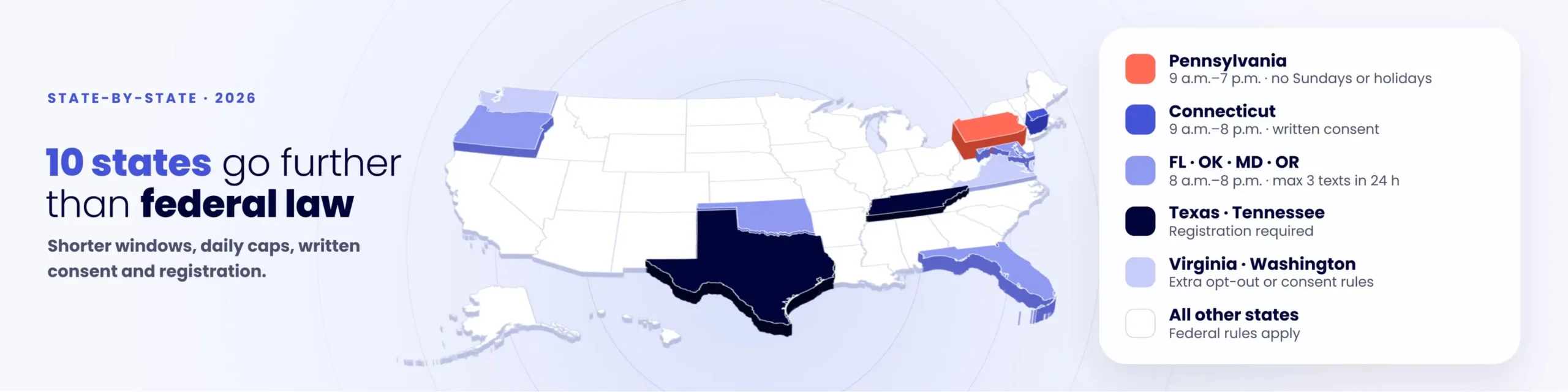
Pennsylvania’s SB 992 brings texts, voicemails and ringless voicemails under its telemarketing law. Solicitations are banned before 9 a.m., after 7 p.m. and all day on Sundays and legal holidays. The law took effect in October 2026, 90 days after the governor signed it on 20 July. (National Law Review)
These three states set the template: texts treated as calls, written consent for automated marketing, an 8 p.m. cutoff and a cap of three messages in 24 hours on the same subject. Florida’s 2023 amendment gave senders a 15-day window after a STOP reply before a lawsuit can be filed. That makes fast, time-stamped opt-out handling a real legal defense. (Goodwin)
Since 2023 Connecticut requires prior express written consent for almost any telephonic sales call, including texts, whether or not an autodialer is used. Its window runs 9 a.m. to 8 p.m. For investors cold texting homeowners, this is one of the highest-risk states (Manatt)
SB 140 made marketing texts “telephone solicitations” from 1 September 2025. Unless an exemption applies, senders must register with the Texas Secretary of State and post $10,000 security before the first text. Violations can be sued on under the Texas Deceptive Trade Practices Act. (Morgan Lewis)
Other states. Several more states, including Alabama, Mississippi and Louisiana, restrict telemarketing hours or Sundays in their own statutes. Whether those rules reach texts varies, so check them before you add those markets.
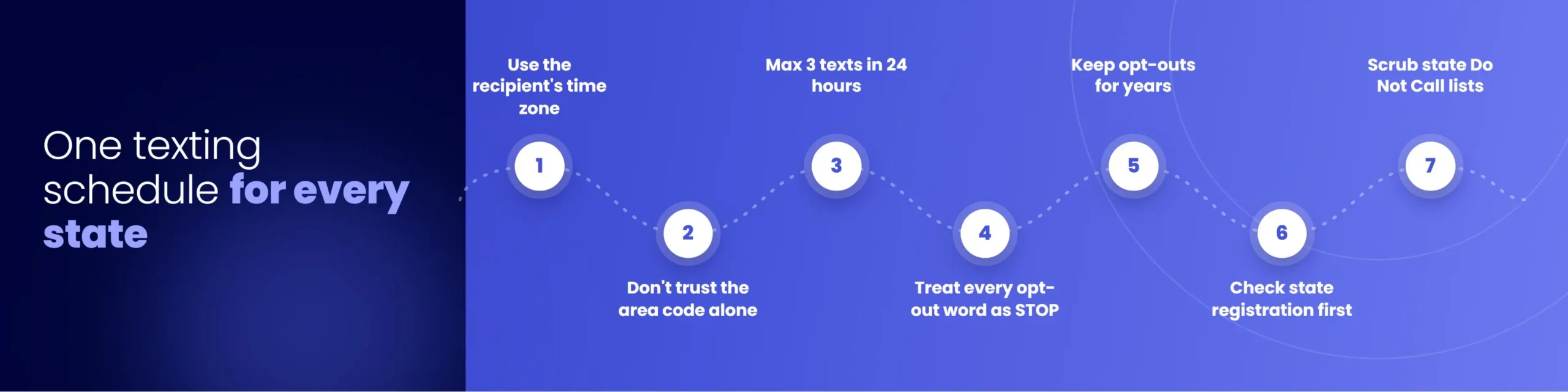
You have two options. Segment your list by the recipient’s state and apply each state’s window. Or use one national window that clears the strictest state: 9 a.m. to 7 p.m., Monday to Saturday, no Sundays or legal holidays, and no more than three texts in 24 hours. Segmenting gives you more sending time; the single window is simpler and safer.
A note for investors texting sellers. Many of these laws are written around selling goods or services. Some investors argue that an offer to buy a house is not a “sale,” but no one should build a texting program on that argument. Treat seller outreach as covered, and be most careful in the written-consent states: Connecticut, Florida, Oklahoma and Maryland.
Under federal law, between 8 a.m. and 9 p.m. in the recipient’s local time. Pennsylvania (9 a.m. – 7 p.m., no Sundays), Connecticut (9 a.m.–8 p.m.) and Florida, Oklahoma, Maryland and Oregon (8 a.m. 8 p.m.) are stricter. The window that clears every state is 9 a.m. to 7 p.m., Monday to Saturday.
In the states covered here, yes. Florida, Oklahoma, Maryland, Connecticut and Virginia already covered texts; Texas added them in September 2025, Oregon in January 2026 and Pennsylvania in October 2026.
For sending hours, Pennsylvania: 9 a.m. to 7 p.m. and no texts on Sundays or legal holidays. For consent, Connecticut, which requires written consent for almost any sales text.
Often yes. Since 1 September 2025, texts count as telephone solicitations, which brings in registration and a $10,000 security unless an exemption applies. The Texas Secretary of State says senders who text only people who opted in need not register for now.
Federal law sets no daily cap. Florida, Oklahoma and Maryland allow three solicitations in 24 hours on the same subject, and Oregon three unless you have a recent business relationship.
The recipient’s location decides, and Florida and Connecticut presume a local area code means a local resident. When the number’s state and the property’s state differ, follow the stricter rule.
RESMS builds and runs real estate texting campaigns with state windows, daily caps and opt-out handling built in from day one. If you want a second pair of eyes on your sending schedule, talk to our team. For the federal side, read our TCPA & 10DLC Compliance Guide.
This article is general information, not legal advice. State laws change often; verify the current statute and consult an attorney before sending.